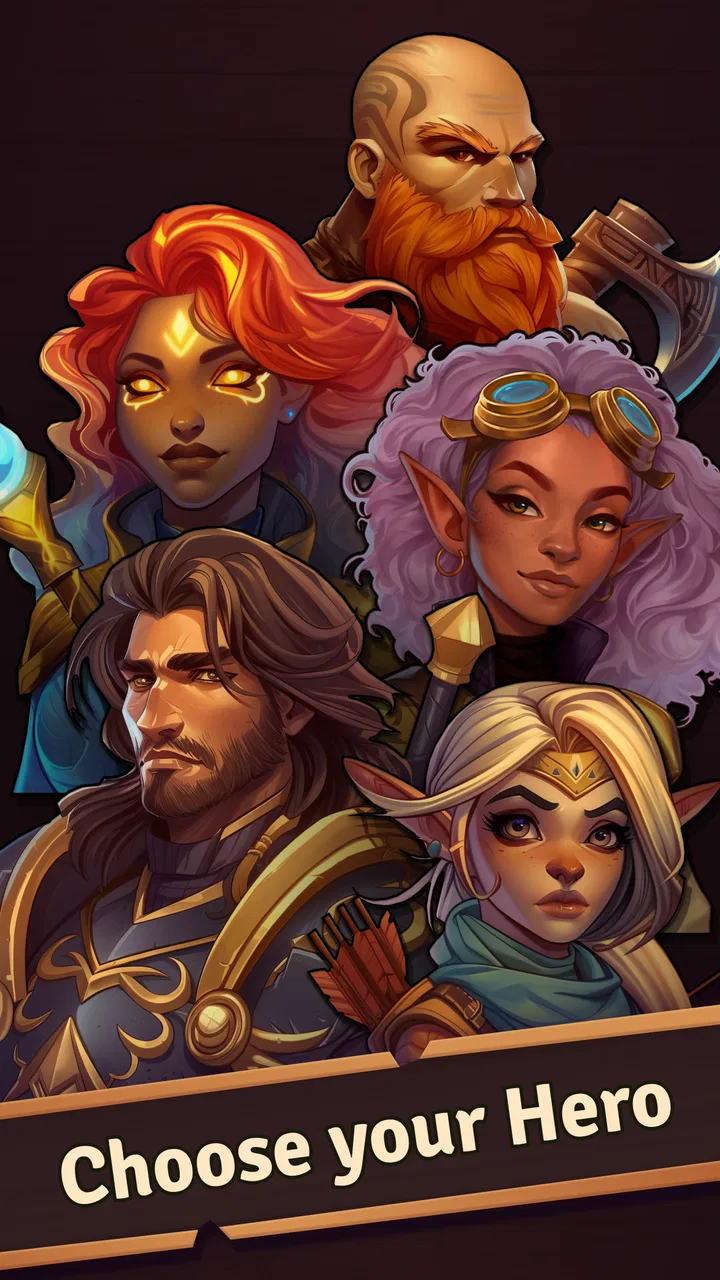
Backpack Brawl — Hero Battles
- 4.6
- Rating
- 1.00M
- Installs
- Free
- Price
 Analysis by App-foxy
I spent time with Backpack Brawl — Hero Battles expecting a quick fantasy strategy game, and that is exactly where it fits best: short, focused 1v1 battles built around preparing a backpack before the fight begins. The central idea is easy to understand, but the decisions become more interesting once I stopped treating the backpack as simple storage and started treating it as my battle plan.
This is a free strategy game from Azur Interactive Games Limited, available for players rated Everyone. It has already attracted more than a million installs, with an average score of 4.6 from roughly 114 thousand ratings. Those figures make sense after playing it: the rules are approachable, the matches are compact, and the fantasy presentation gives the tactical choices a clear identity without making the game difficult to read.
My experience was strongest when I had only a few minutes and wanted something more thoughtful than an idle distraction. I could make a preparation decision, watch the duel unfold, and then immediately think about what I would change next time. The game is not built around long exploration or a large story campaign. Its appeal comes from repeatedly refining a loadout and learning why a seemingly clever arrangement failed.
You May Also Like

 Blood Strike: 2.5 Anniversary
Blood Strike’s Loadouts Turn Every Drop Into a Tactical Gamble
A close look at Blood Strike’s custom loadouts: how fast access to signature weapons reshapes its battle royale rhythm, rewards preparation, and narrows the gap between fights.

 Pandora - Music & Podcasts
Pandora’s Music Is Easy to Start, but Harder to Recover
Pandora’s strength is its low-effort path from a seed to a station. Its weak spot is how much confidence it asks you to place in connection, setup, and quiet recovery.

 8 Ball Pool
 Is Built on Rivalries, Rematches, and Routine
A close look at the rivalries, rematches, shared routines, and unanswered safety questions that turn a quick pool match into a persistent mobile community.

 Samsung Music
’s Quiet Strength Is Playing What You Already Own
Its reach comes less from spectacle than from dependable access to a personal library. That simplicity is both the app’s strongest retention engine and its ceiling.

 AccuWeather: Weather Radar
AccuWeather Review: A Quick, Clear Forecast for Everyday Decisions
For everyday plans, the best forecast is the one you can understand quickly. AccuWeather makes rain timing, radar, and local conditions easy to act on, with a few trade-offs.

 Hill Climb Racing
Why Hill Climb Racing Still Turns Crashes Into One More Run
A tiny car, a bumpy hill and one more upgrade: Hill Climb Racing keeps resurfacing because its simple chaos makes every near-miss feel personal.
More From Our News Desk



Backpack decisions are the real opening goal
The first goal is not simply to win every encounter. It is to understand how the backpack turns a collection of items into a working combat setup. The game asks me to pack smartly, but the useful lesson is that “smart” does not always mean filling every available space. A crowded arrangement can be less effective than a smaller one that supports a clear plan.
Early matches work well as a tutorial through practice rather than lengthy explanation. I quickly learned to look at the whole arrangement instead of judging each item in isolation. A strong piece may be wasted if it does not fit the rest of the setup, while an ordinary-looking choice can become valuable when it completes a useful combination. That makes each preparation screen feel like a small puzzle before the duel starts.
My practical advice is to avoid changing everything after a loss. I had better results when I identified the one decision that probably caused the problem: poor use of space, an awkward combination, or a plan that was too dependent on one part of the loadout. Changing one element at a time makes the result easier to understand and turns defeat into information rather than random frustration.
This is also where the game separates itself from more conventional mobile strategy titles. In many alternatives, the main decision is which character or unit to send into battle. Here, the arrangement itself receives much of my attention. That creates a more personal sense of ownership because the result feels connected to how I packed and adjusted the backpack, not only to a preset team choice.
Why the first victories feel useful
Winning an early duel is satisfying because it confirms that the preparation mattered. I was not merely tapping through an automatic result; I had made a prediction about how the setup would perform. Even when the battle phase is easier to observe than to control, the important work happened beforehand.
The early goals are therefore nicely layered. At first, I wanted to understand the basic rhythm. Soon after, I wanted to make a cleaner arrangement, then test whether a different approach could solve a problem that had stopped me. This gives the opening portion a natural sense of direction without requiring a complex story or a large number of menus.
There is a useful trade-off here. Players who enjoy experimenting will find plenty to think about in small adjustments. Players who prefer direct action may wonder why the preparation screen receives so much importance. If you want a game where your main satisfaction comes from controlling every second of a fight, this may feel indirect. If you enjoy planning and watching a plan prove itself, the structure is much more appealing.
Progress is easiest to notice through better decisions
The clearest progress signal is not just moving forward; it is recognizing mistakes that would have confused me earlier. I began to notice when I was packing for an imagined ideal situation instead of the actual challenge in front of me. That change in judgment made victories feel more earned than simply obtaining a stronger option.
There is also a satisfying loop between a failed duel and the next preparation attempt. I could return to the backpack with a specific question: was the layout inefficient, was the combination too narrow, or did I commit too heavily to one idea? That question gives the next match a purpose. Without it, repeated battles would quickly become routine.
One of the less obvious strengths is that the game makes small improvements visible. A minor adjustment can change the way the entire setup behaves, so I did not always need a dramatic unlock to feel that I was learning. This matters for mobile play because it gives a short session a conclusion even when I do not make major progress.
At the same time, the progression can feel less tangible for anyone who measures progress mainly through obvious rewards. The game’s most important advancement is partly in the player’s understanding. If you want a constant stream of clearly announced milestones, this approach may seem restrained. I found it more rewarding once I accepted that better judgment was part of the progression.
How to use short sessions without wasting them
A realistic way to play is to treat each session as a small experiment. Before starting a duel, I choose one thing to test rather than trying to rebuild the entire backpack. Afterward, I remember the result and make one targeted change. This works well during a commute, a break, or a few minutes before bed because the session has a clear beginning and end.
I would not recommend playing every match on autopilot. The battles may be quick, but the useful information is easy to miss if I only watch for the winner. I get more from observing which part of the preparation seemed to contribute to the result. That habit helps prevent the common mobile-game mistake of repeating the same setup and hoping the outcome changes.
Another practical tip is to keep a simple mental distinction between a bad idea and a badly arranged good idea. Losing does not always mean the overall strategy was wrong. Sometimes the concept was sound but the backpack did not support it efficiently. Making that distinction saves time and encourages experimentation instead of constant replacement.
The difficulty curve rewards patience, but the pace has pressure points
The challenge develops through the need to make more deliberate choices. At the beginning, understanding the basic relationship between packing and combat is enough to create momentum. Later, simply collecting appealing options is not sufficient. I had to think about how choices worked together and whether the setup could survive the kind of opposition I was facing.
This creates a fair difficulty curve when I approach it as a strategy game rather than a reflex game. The challenge is not mainly about tapping faster. It is about noticing weaknesses before committing to a duel. That makes the game suitable for players who enjoy planning, but it also means a careless preparation can feel more punishing than expected.
The difficulty is most enjoyable when a loss points toward a solution. I like being able to look back and understand what I should test next. The less enjoyable moments happen when the result feels difficult to interpret, because then the next attempt can become guesswork. My best sessions were the ones where I could explain the defeat in one sentence and act on that explanation immediately.
Compared with a typical auto-battler, this game gives more importance to the arrangement phase. Compared with a traditional turn-based strategy game, it offers less moment-to-moment control once the duel is underway. That middle ground is its identity. It is more thoughtful than a passive progression game, but less hands-on than a game where every attack and movement is selected manually.
Where the challenge can become repetitive
The same focused loop that makes the game accessible can also narrow its appeal. If I am not in the mood to analyze a backpack, the preparation stage can feel like work rather than play. The battles are useful tests of a plan, but players who need constant novelty may find the repeated structure familiar sooner than expected.
I also noticed that the game asks me to tolerate some uncertainty. Not every result gives a perfectly obvious explanation, and that can make experimentation feel slower. The right response is not to make random changes. It is better to keep the core idea, alter one part, and give the next duel a clear purpose.
This is an important distinction for new players: difficulty does not always mean the game is demanding faster reactions. Often, it means the current setup has reached its limit. If I treated every setback as a demand for a stronger item, I missed the more interesting lesson about arrangement and balance. The game rewards curiosity more than impatience.
Free access and the temptation to keep pushing
The game is free to download and play, with in-app purchases ranging from twenty-nine cents to $114.99 per item. That broad range is worth keeping in mind before getting deeply invested. I can enjoy the strategic loop without treating spending as part of the basic entry requirement, but the presence of purchases adds a potential pressure point for players who dislike monetized progression.
My advice is to decide early what kind of player you want to be. If I focus on learning the backpack and improving through experiments, the game feels like a compact strategy experience. If I start measuring every setback against what might be obtained through spending, the relaxing short-session rhythm becomes less comfortable. Setting a personal limit helps preserve the part of the game that works best.
The retention design is strongest when I return because I have a tactical question to answer. It is weaker when I return only because I feel pushed to maintain momentum. That difference matters. A good reason to continue is wanting to test a refined setup; a less satisfying reason is feeling that stopping would waste previous effort.
For that reason, I recommend playing in deliberate bursts rather than endlessly repeating matches. Stop after a meaningful result, whether it is a win that confirms a change or a loss that clearly reveals a weakness. This keeps the loop from becoming mechanical and makes the next session feel like a fresh test instead of an obligation.
Who will enjoy it, and who should choose something else
I would recommend it to players who like inventory puzzles, fantasy duels, and strategy that fits into short sessions. It is especially suitable if you enjoy improving a plan through small changes and watching the consequences. The Everyone rating also makes it approachable for a broad audience, although the strategic thinking may appeal more to older children and adults than to players seeking purely casual tapping.
I would skip it if your priority is a deep campaign, direct character control, or a large story-driven world. This is not the best choice for someone who wants to move units around a battlefield or make a decision during every attack. A conventional real-time strategy game will offer more active control, while a story RPG will provide more narrative motivation.
It may also be a poor fit if you strongly dislike repeating encounters to refine a setup. Repetition is not a side effect here; it is part of the learning model. The game expects me to revisit the same kind of problem with a better arrangement. That is satisfying when I enjoy optimization and tiring when I want constant forward movement.
Device expectations and practical commitment
The game supports devices running Android 7.0 or later, which makes it accessible on a wide range of Android hardware. The current version is 3.1.1, so players should keep the app updated through their normal store process to use the current release available to them. I found its format naturally suited to a phone because each decision is compact and the backpack is easier to consider in a focused screen than in a sprawling interface.
The important commitment is not storage or session length; it is attention. A match may be convenient to start, but I get the most value when I pause long enough to understand the preparation choices. This is a game for someone willing to think briefly and repeatedly, not for someone who wants to leave a battle running in the background without engaging with the outcome.
My progression verdict
After playing it, I think the progression succeeds because it gives early victories a clear purpose, makes improvement visible through better decisions, and raises the challenge without abandoning the simple backpack concept. The strongest unlock is the player’s own understanding of how to build a more coherent setup. That is a quieter form of advancement, but it suits the compact duel format.
The main limitation is equally clear: the loop depends heavily on enjoying preparation and repetition. Players who need a story, direct combat control, or nonstop variety may move on quickly. The purchase range also means cautious players should keep an eye on their spending habits rather than letting the desire to overcome a difficult stretch make decisions for them.
For me, Backpack Brawl — Hero Battles works best as a thoughtful mobile strategy game rather than a full-scale fantasy adventure. I would recommend trying it when you want a short tactical challenge and are happy to learn through small adjustments. Its best moments come when a failed duel sends me back to the backpack with a specific idea, and the next battle proves whether that idea was actually good.
FAQs for Backpack Brawl — Hero Battles
01What is Backpack Brawl — Hero Battles about?
Backpack Brawl — Hero Battles is a strategic combat game where players engage in thrilling battles using unique heroes, each equipped with special abilities. The game combines elements of strategy, skill, and quick thinking, requiring users to assemble a team of heroes and outmaneuver opponents in tactical arenas.
02Is Backpack Brawl free to play?
Yes, Backpack Brawl — Hero Battles is free to download and play on both Android and iOS platforms. However, it offers in-app purchases for players who wish to enhance their gaming experience by unlocking special items, heroes, or additional features.
03What are the system requirements for Backpack Brawl?
To ensure smooth gameplay, Backpack Brawl requires devices running Android 5.0 or higher and iOS 11.0 or later. Adequate storage space is needed for downloading the app and any future updates. Additionally, a stable internet connection is recommended for optimal performance and multiplayer battles.
04How can I improve my skills in Backpack Brawl?
Improving skills in Backpack Brawl involves regularly practicing battles, understanding each hero's abilities, and developing strategic plans for different opponents. Participating in online forums or communities can also provide tips and insights from experienced players. Watching tutorial videos may further enhance gameplay strategies.
05Are there any age restrictions for Backpack Brawl?
Backpack Brawl — Hero Battles is designed for players aged 12 and up. The game includes mild fantasy violence and strategic elements that may not be suitable for younger audiences. Parents are advised to review the game content and set appropriate restrictions based on individual preferences.
Pros
- Engaging graphics and animations.
- Smooth and intuitive controls.
- Diverse character selection.
- Regular content updates.
- Strategic battle mechanics.
Cons
- In-app purchases can be pricey.
- Requires constant internet connection.
- Occasional matchmaking issues.
- Limited offline features.
- Battery drains quickly during play.

Backpack Brawl — Hero Battles
Gallery